Hugging Face Just Launched a $399 Robot Duck. It’s More Interesting Than It Sounds.
Hugging Face — best known as the platform where developers go to find and share open-source AI models — just launched a robot. It’s called the Microduck, it costs $399, it’s shaped like a duck, and it is genuinely one of the more interesting consumer tech launches of the year.
Pre-orders opened yesterday. First deliveries are targeted before Christmas 2026 in the US, Canada, the EU, the UK, Norway, Switzerland, Japan, and South Korea. The Microduck comes in four colours: Cream, Graphite, Lavender, and Sky.
The duck aesthetic is playful, but the engineering underneath it is serious. Here’s what this robot actually is — and who it’s for.
What Microduck Actually Does
Microduck stands 25 centimetres tall and weighs about 800 grams. Under its plastic shell sit 15 motors distributed across its legs, torso, head, and beak. That beak opens and closes — it’s a functional gripper capable of picking up objects weighing up to 800 grams.
The robot ships with seven pre-trained behaviours out of the box: walking, crouching, squatting, recovering from falls, kicking a ball, picking up objects, and — yes — roller skating. The recovery behaviour is not a party trick. It’s a core requirement for any bipedal robot, since falling is a regular part of how they operate. The fact that Microduck can get back up on its own without human intervention is a non-trivial engineering achievement at this price point.
The sensor array is more capable than the price suggests. Microduck ships with a wide-angle camera, a LiDAR unit, two inertial measurement units for tracking orientation and movement, a microphone, a speaker, NFC, Wi-Fi, and Bluetooth. Everything it needs to perceive its environment and respond to it is on board — no external compute required for basic behaviours.
The Open-Source Part Is the Actual Product
The hardware is interesting. The software story is more important.
Microduck ships with a full open-source reinforcement learning stack on GitHub under an Apache 2.0 licence. The training pipeline uses PPO (Proximal Policy Optimisation) in the MuJoCo physics simulator — meaning you train new behaviours in simulation first, then push the trained policy to the physical robot at 50Hz. The simulation-to-real transfer pipeline — getting a policy trained in a virtual environment to work on actual hardware — is one of the hardest problems in robotics, and Hugging Face’s stack handles the heavy lifting.
This is the DNA of the Hugging Face model: open everything, let the community improve it, and build a platform around collective development. Hugging Face CEO Clément Delangue framed the launch as “welcoming the era of open-source affordable robots to democratise physical AI.” That’s not just marketing — it’s a genuine strategic position. The same collaborative development model that built Hugging Face’s AI model library is being applied to physical robots.
Who Is Microduck Actually For?
This is the most important question to answer honestly, because Microduck is not a consumer gadget in the conventional sense.
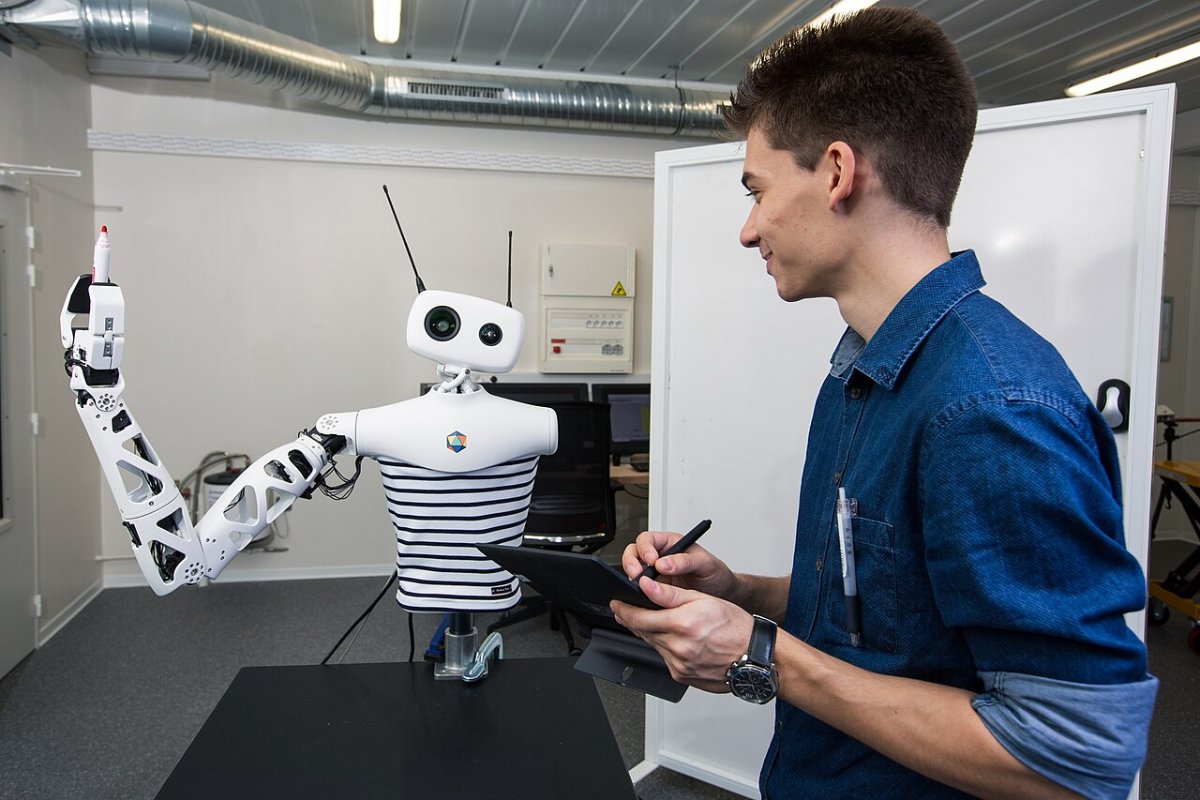
It is a developer and researcher tool. The people who will get the most out of it are: robotics researchers who want a physical platform for reinforcement learning experiments without a five-figure lab budget; developers curious about physical AI who want to understand how policies transfer from simulation to hardware; students in robotics, computer science, or AI programmes who need a hands-on learning platform; and technically curious hobbyists who want to go beyond software and start working with physical machines.
It is not a smart home device. Microduck does not integrate with Alexa or Google Home. It doesn’t follow you around or remind you of appointments. If you want a domestic robot that does useful household tasks autonomously, Microduck is the wrong product — and that category doesn’t really exist yet at any price point.
If you want to teach a physical robot to do something it doesn’t already know how to do — and to understand the actual mechanics of how that works — Microduck is the most accessible entry point available today.
The Honest Caveats
A few things worth knowing before clicking pre-order. The $399 introductory price covers the robot, one battery, a USB-C cable, and a game controller. Additional batteries, a charger pack, and replacement motors are sold separately — and you will likely need replacement motors eventually, because reinforcement learning training involves a lot of falling, and falling is hard on servo gears.
Budget $399 for the robot and at least $50-$100 for consumables if you plan to train it seriously. That’s still a remarkably low barrier for hands-on robotics research, but it’s worth knowing the full cost going in.
Also worth noting: the Nvidia acquisition of Hugging Face — reportedly at a $13 billion valuation — has not yet closed. If it does, the ownership and open-source commitments of the platform could change. For now, everything Hugging Face has shipped remains open under permissive licences, and there’s no indication that will change. But it’s a variable worth monitoring. For more on that story and the broader physical AI trend, see our coverage of Bezos’s $12 billion bet on AI that designs physical things and our overview of 10 emerging technologies transforming the future.
The Bottom Line
Microduck is the most accessible entry point into hands-on reinforcement learning robotics that has ever existed. At $399 with a full open-source stack, it removes the financial barrier that has historically kept physical AI research confined to well-funded labs. Whether you’re a developer, a researcher, or a technically curious person who wants to understand how robots actually learn — this is the product that makes that accessible.
Pre-orders are open now at pollen-robotics.com. Deliveries target before Christmas 2026.
Read more tech related articles here.