
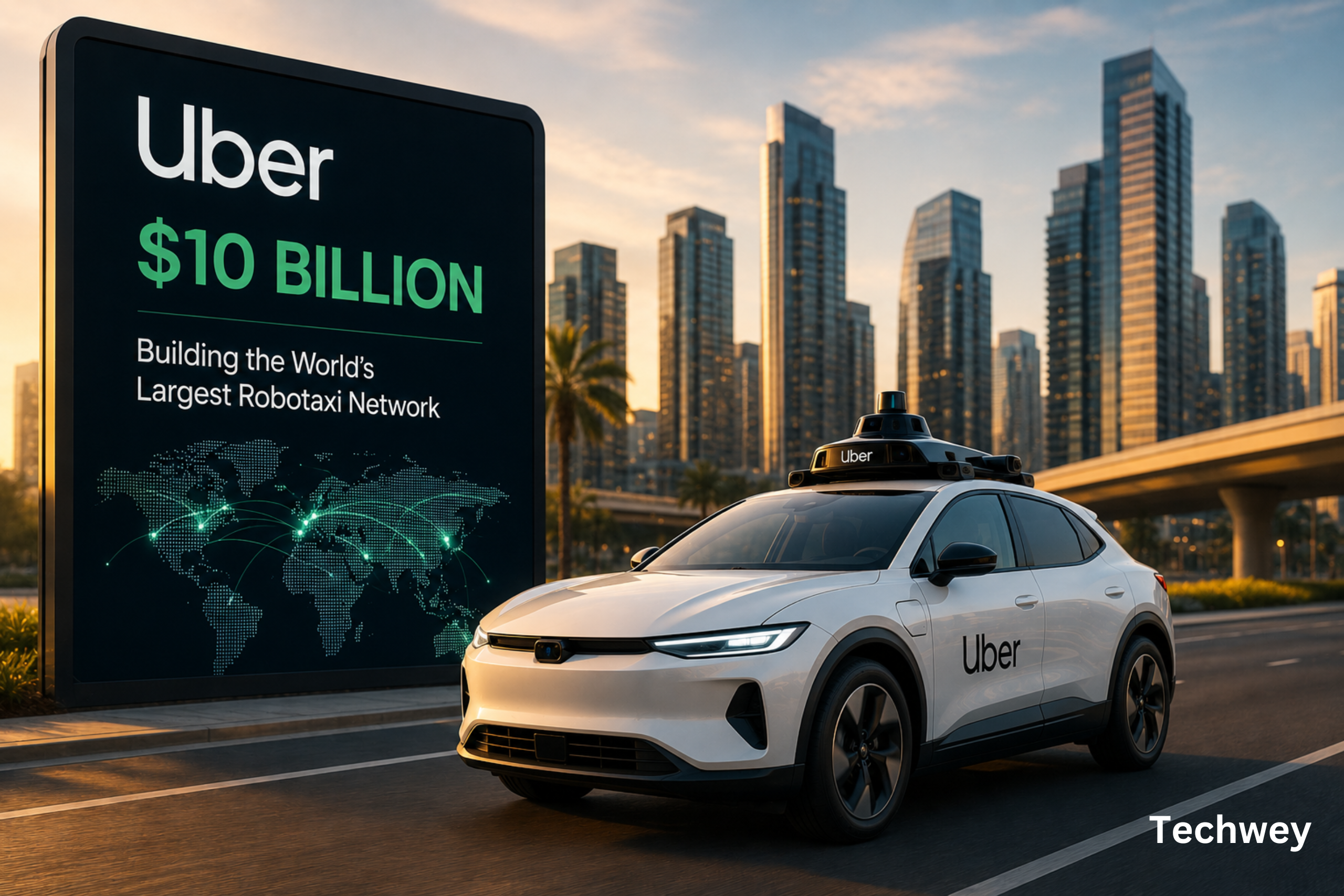
Uber Is Spending $10 Billion to Build the World’s Largest Robotaxi Network
Uber CEO Dara Khosrowshahi dropped a number this week that reframes everything about the company’s future. Uber is targeting a fleet of roughly 120,000 driverless vehicles (Robotaxi) and autonomous operations across at least 15 cities in 2026 — backed by $10 billion in investment across vehicles, infrastructure, and strategic partnerships.
That’s not a pilot programme. That’s a full-scale transformation of the world’s largest ride-hailing platform into an autonomous vehicle empire — and Uber is doing it without building a single self-driving car itself.
The Strategy: Own the Platform, Not the Technology
When Uber sold its autonomous driving division to Aurora in 2020, it made a clear bet: that the best position in the AV market isn’t building the technology, but controlling the marketplace that deploys it. Rather than rebuilding the autonomous-driving division it sold in 2020, Uber is taking a platform approach, partnering with and investing in companies developing the vehicles and self-driving systems.
It’s the same playbook Uber used to build its original ride-hailing business — own the demand, own the app, own the customer relationship, and let others supply the vehicles. The difference now is that the vehicles drive themselves.
Uber’s expansion has benefited from collaborations with tech companies and manufacturers worldwide as it targets launching robotaxi services in more than 10 markets across at least 15 cities — about half in the US and half internationally — by the end of 2026. And Uber plans to operate robotaxis in 28 cities globally by 2028, CEO Dara Khosrowshahi said during the company’s Q2 2026 earnings call.
The Partner Network: Everyone Except Waymo
The sheer breadth of Uber’s AV partnerships is striking. The company has deals — and in many cases equity stakes — across nearly every serious autonomous vehicle developer in the world.
Uber and Rivian have partnered to deploy up to 50,000 fully autonomous R2 robotaxis, with initial deployments expected to begin in San Francisco and Miami in 2028, expanding to 25 cities by 2031. Uber will invest up to $1.25 billion in Rivian through 2031.
Lucid, Nuro, and Uber are partnering to launch a next-generation robotaxi service — combining premium electric vehicles, proven self-driving technology, and Uber’s global ride-hailing platform. Uber plans to deploy 35,000 or more Lucid vehicles equipped with Nuro’s self-driving system over six years.
Beyond Rivian and Lucid, the roster includes Wayve (UK-based, recently permitted in London), WeRide (already operating driverlessly in Dubai), Avride (Dallas, though still with safety drivers), Baidu’s Apollo Go (international markets), Pony.ai, Volkswagen, Stellantis, Motional, Zoox, and Hertz’s new Oro Mobility division handling fleet operations for the Lucid programme in San Francisco.
The Wayve Moment: London Gets Robotaxis
One of this week’s most significant milestones came from the UK. Wayve had received permits from Transport for London to launch a commercial robotaxi service with a supervising driver behind the wheel. It’s not fully driverless yet — but it’s the first commercial AV permit ever granted in London, and it opens a new European regulatory chapter for the industry.
Uber and Stellantis have also announced a joint deal with Wayve to develop and deploy driverless robotaxis across Europe and North America — meaning the London permit is just the starting point for a much larger rollout.
The Economics: Does This Actually Make Money?
Robotaxis eliminate the single largest cost in ride-hailing: the driver. Over the past 12 months, Uber’s free cash flow has reached about $10.1 billion as bookings continue to grow. That’s the war chest Uber is deploying from — not a desperate pivot, but an offensive move from a company generating serious cash.
The unit economics of autonomous rides are still being proven at scale. Most AV operators are not yet profitable — they’re building toward profitability as fleet sizes grow and cost-per-mile falls. WeRide’s Middle Eastern subsidiary has achieved operational profitability in its Robotaxi business — a meaningful early signal that the model can work, at least in controlled market conditions.
The economics remain uncertain. But Uber’s platform-based strategy means it doesn’t carry the full capital burden of AV development. It shares the risk across dozens of partners while capturing the margin on every ride booked through its app.
What This Means for Drivers — and Passengers
For passengers, the transition is gradual. Uber now offers robotaxi rides in four US cities, with two more to come by the end of this year. In most markets, human-driven Uber rides aren’t going anywhere soon. The robotaxi fleet is additive — a new category alongside existing services, not an overnight replacement.
For drivers, the picture is more complicated. Uber has something most autonomous-driving startups do not: more than 200 million customers already using its network. That demand base is the asset. Whether Uber uses it to complement or gradually displace its human driver network will be one of the defining business questions of the next decade. For more on how autonomous technology is reshaping transport and cities, see our overview of 10 emerging technologies transforming the future.
Read more tech related articles here.