Humanoid Robots Are Coming to Work — And They’re More Ready Than You Think
For decades, humanoid robots were a Hollywood fantasy — something you’d see in a sci-fi film but never in a real factory, warehouse, or office. That era is over. Right now, companies like Tesla, Figure AI, Boston Dynamics, and Agility Robotics are deploying bipedal robots in real work environments, doing real jobs, for real companies.
And the pace is accelerating faster than most people realize.
We are not talking about a distant future. We are talking about robots that can sort packages, carry boxes, assemble components, and navigate dynamic physical environments — today. The question is no longer whether humanoid robots will enter the workforce. It’s how quickly, and what happens when they do.
The Companies Leading the Charge
Tesla Optimus
No company has put humanoid robots in the public spotlight more aggressively than Tesla. Elon Musk unveiled the Tesla Optimus — also called the Tesla Bot — with bold claims: a general-purpose humanoid designed to perform “unsafe, repetitive, or boring” tasks that humans don’t want to do.
Optimus has moved from concept to operational prototype faster than many expected. Tesla has been testing the robot inside its own manufacturing facilities, training it on tasks using the same AI and computer vision stack that powers its self-driving cars. The goal, per Musk, is to eventually manufacture millions of units annually and sell them at a price point under $20,000 — potentially making humanoid robots a mass-market product, not just an enterprise one.
Whether Tesla meets those timelines is a fair question. But the engineering progress is real, and few companies have Tesla’s combination of AI expertise, manufacturing scale, and capital to execute on it.
Figure AI
If Tesla is making the loudest noise, Figure AI is making the most commercially credible moves. The San Jose-based startup, backed by investors including Microsoft, Nvidia, Jeff Bezos, and OpenAI, has deployed its Figure 01 robot in a partnership with BMW at a manufacturing plant in South Carolina.
The significance of that can’t be overstated. This isn’t a demo. This isn’t a controlled lab environment. Figure 01 is performing real production tasks on a real automotive assembly line.
Figure also made headlines with a remarkable demo showing its robot holding a natural conversation, reasoning about its environment, and completing tasks based on verbal instructions — all powered by OpenAI’s language models running on its onboard systems. It’s a glimpse at what happens when physical robotics meets advanced AI.
Boston Dynamics
Boston Dynamics has been building robots longer than most of its newer competitors have existed. Its humanoid robot Atlas has evolved dramatically — moving from a hydraulically powered research prototype to an all-electric system capable of fluid, dynamic movement that looks genuinely astonishing.
The company, now owned by Hyundai, has shifted Atlas toward commercial applications in automotive manufacturing, with Hyundai factories serving as the primary proving ground. Atlas’s dexterity and mobility still lead the field in many respects, and its transition to electric actuation makes it far more practical for real-world deployment.
Agility Robotics and Amazon
Agility Robotics’ Digit robot has found an early commercial partner in Amazon. The e-commerce giant — which operates some of the most demanding warehouse environments in the world — has been testing Digit for tote handling and movement tasks inside its fulfilment centres.
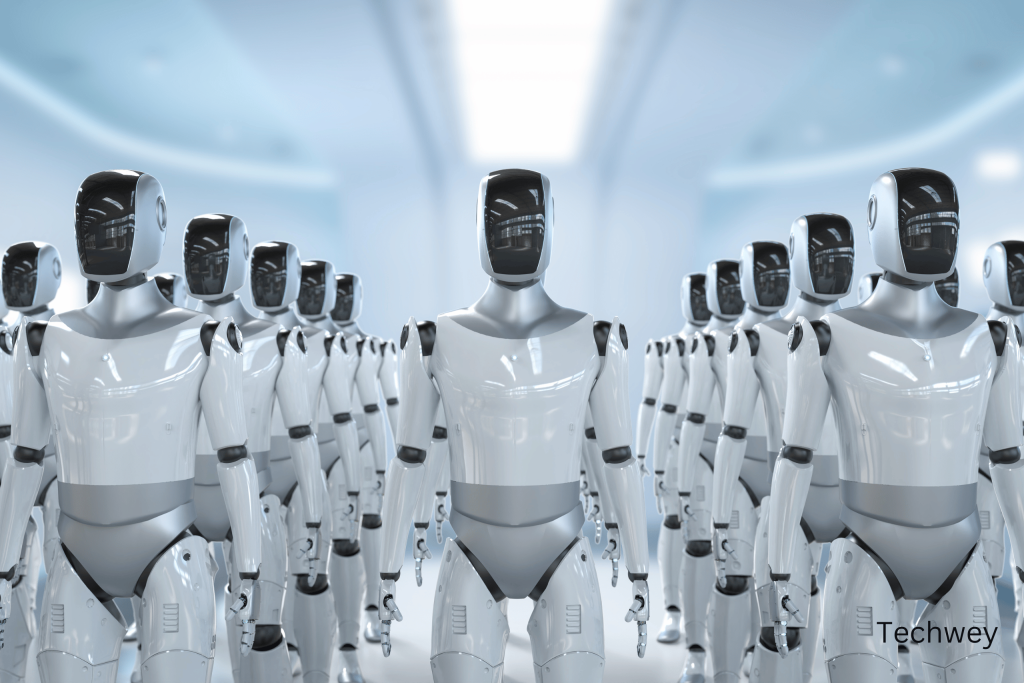
For Amazon, humanoid robots are a natural fit: the work is repetitive, physically demanding, and difficult to automate with traditional fixed robotic systems. A humanoid robot designed to work in spaces built for humans doesn’t require retrofitting the entire warehouse.Why Humanoid — Why Now?
A reasonable question: why humanoid? The world already has plenty of industrial robots. What makes the bipedal, human-shaped form factor worth the added complexity?
The answer is deceptively simple: the world is built for humans. Every tool, every shelf height, every staircase, every door handle — all of it was designed around the human body. A robot that matches that form factor can work in existing spaces without expensive retrofits.
Traditional industrial robots are powerful but fixed. They work in cages, on assembly lines built around them. A humanoid robot can, in theory, step into almost any human workplace and start operating.
That flexibility is the core value proposition — and it’s what’s driving billions of dollars in investment into this space right now.
The AI Layer Is What Changed Everything
Humanoid robot hardware has been technically impressive for years. What was missing was the intelligence layer — the ability to perceive the environment, reason about it, and take actions that weren’t explicitly pre-programmed.
That gap has been narrowing rapidly thanks to advances in large language models, computer vision, and what researchers call “embodied AI” — AI systems designed to operate in and interact with the physical world.
Google DeepMind’s robotics research has produced systems that can generalize learned behaviours across new environments. Stanford, MIT, and Carnegie Mellon are producing research that’s feeding directly into commercial robotics systems. And the data flywheels are beginning to spin — the more these robots operate in the real world, the more they learn, and the more capable they become.
The combination of mature hardware and rapidly improving AI is what makes 2026 feel genuinely different from every previous year in humanoid robotics.
What Jobs Are Robots Taking First?
Let’s be specific. The early use cases for humanoid robots are concentrated in:
- Warehouse and logistics — Picking, sorting, packing, and moving goods in environments that are too dynamic for traditional automation
- Automotive manufacturing — Assembly tasks, parts handling, quality inspection in factory settings
- Retail and hospitality — Restocking shelves, cleaning, and front-of-house tasks in structured environments
- Construction — Carrying materials, performing repetitive tasks on job sites (still early, but in active development)
- Domestic assistance — Long-term goal, not yet commercial, but the direction multiple companies are heading
The common thread: physically demanding, repetitive, or dangerous work that humans either struggle to fill with staff or shouldn’t have to do at all.
The Concerns Worth Taking Seriously
The excitement is real. So are the concerns.
Job displacement is the most immediate and politically charged issue. Warehouse workers, factory line workers, and logistics staff are among the most likely to see their roles affected first — and these are predominantly working-class jobs in economies that have few alternative pathways for displaced workers.
The counterargument — that new technology creates new jobs — is historically true but not automatically reassuring to a 45-year-old warehouse operative in Lagos, Detroit, or Manchester who needs a job today.
Safety is another live concern. A heavy, powerful robot operating alongside humans in a dynamic environment introduces new risks. Regulatory frameworks for human-robot co-working are still being developed, and standards vary widely by region.
Data and surveillance is a third dimension. Robots embedded in workplaces are, by definition, always-on sensors. The data they collect about worker behaviour, productivity, and movement raises serious questions about workplace surveillance that haven’t been fully addressed.
What Africa Should Watch
Africa’s large and growing working-age population has often been positioned as an economic advantage. But if humanoid robots significantly reduce the cost of manufacturing and logistics in Western economies, some of the offshoring dynamics that have created industrial jobs in parts of Africa and Asia could reverse.
This isn’t a reason for panic. It is a reason for proactive policy thinking — particularly around workforce development, education in robotics and AI, and industrial strategy. African governments and businesses that engage with these trends now will be far better positioned than those that don’t.
On the opportunity side, Africa’s growing tech and engineering talent pool means there’s a realistic path to becoming a player in robotics development and deployment — not just a recipient of technology built elsewhere.
The Bottom Line
Humanoid robots are no longer a concept. They are a product category, attracting serious capital, deploying in real workplaces, and improving at a pace that surprises even their creators.
The next five years will be decisive. The companies and governments that think clearly about how to harness this technology — while honestly addressing its disruptions — will shape what the age of physical AI looks like for the rest of us.
The robots are coming to work. The real question is whether we’re ready to work alongside them.
Read more tech related articles here: Techwey