
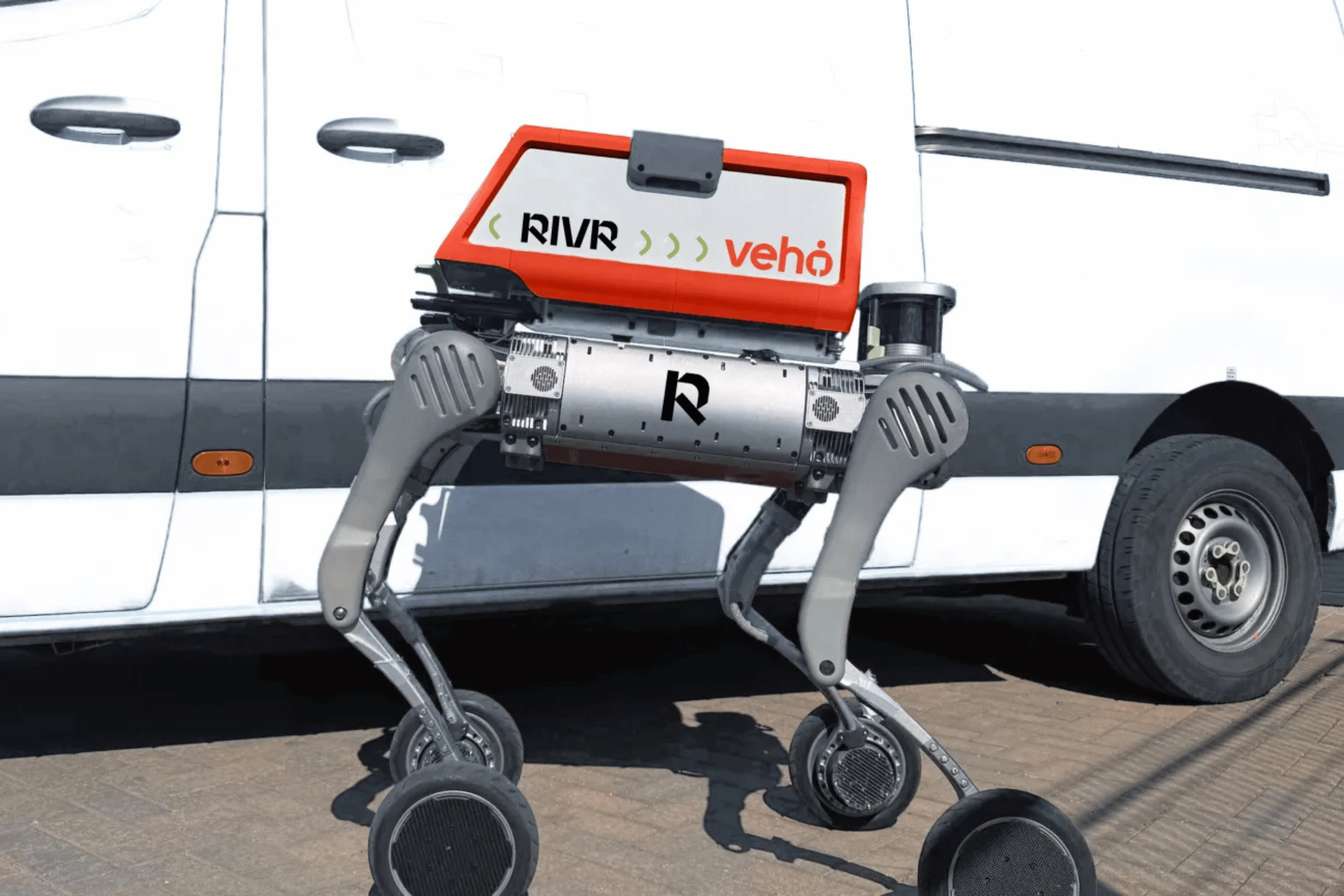
Amazon quietly acquired Rivr, a Zurich-based robotics startup developing four-legged, wheeled delivery robots capable of climbing stairs and navigating difficult terrain, the company confirmed March 19. The Amazon Rivr acquisition robotics deal, announced through a notice sent to third-party delivery contractors rather than public press release, marks a strategic pivot toward autonomous last-mile delivery following Amazon’s 2022 shutdown of its Scout wheeled robot program. With approximately $25 million in total funding and an estimated $100 million valuation, Rivr represents Amazon’s latest bet that physical AI and robotics can reduce delivery costs—though layoffs following the acquisition and CEO Andy Jassy’s public forecast that AI will shrink Amazon’s overall workforce raise questions about whether robots will truly work “alongside” delivery associates or eventually replace them.
The Amazon Rivr Acquisition Robotics Timeline
According to TechCrunch, Amazon had been tracking Rivr’s progress long before the acquisition. The Amazon Industrial Innovation Fund and Bezos Expeditions—the venture capital firm started by Amazon founder Jeff Bezos—invested in Rivr as part of a $22.2 million seed round that closed in March 2024.
By converting a seed investment into a full acquisition within just two years, Amazon followed the same playbook it used with Kiva Systems, the warehouse robotics company Amazon acquired in 2012 for $775 million. The strategy: invest early, validate through pilots, observe commercial traction, then absorb the entire company rather than continuing as an external partner.
The Amazon Rivr acquisition robotics deal terms were not disclosed, but Winbuzzer’s analysis estimates Rivr was valued at approximately $100 million based on its total funding and market positioning. This represents a significant premium over the seed round valuation, rewarding early investors including Bezos and Amazon’s industrial fund.
What Makes Rivr’s Robots Different
The technology central to the Amazon Rivr acquisition robotics strategy is Rivr’s hybrid wheel-leg design, which CEO and co-founder Marko Bjelonic has described as “a dog on roller skates.” According to The Robot Report, the four-legged chassis allows the robots to handle stairs, curbs, gates, uneven paths, and other real-world terrain that defeated Amazon’s earlier Scout robot, which used only wheels.
Technical specifications for the Rivr TWO platform include:
Speed: Up to 15 kilometers per hour (9.3 mph) on wheels Payload Capacity: 30 kilograms (approximately 66 pounds) Terrain Capabilities: Stairs, curbs, uneven surfaces, gates, and obstacles Autonomous Navigation: AI-powered routing and obstacle avoidance Power Source: Onboard battery enabling multi-hour operation
The combination of wheels for efficient flat-surface travel and articulated legs for obstacle navigation represents a technical breakthrough. Most sidewalk delivery robots struggle with the “last 50 feet” problem—getting from the sidewalk to someone’s front door often involves steps, uneven walkways, or other barriers that wheeled robots cannot traverse.
Amazon’s Scout program shut down in 2022 precisely because those limitations proved too restrictive. Scout could operate only on level sidewalks and streets, requiring human delivery associates to carry packages the final distance to doorsteps. The Amazon Rivr acquisition robotics deal aims to solve that problem through terrain-capable machines that can complete true doorstep delivery autonomously.
From Swiss-Mile to Rivr: The Rebrand Journey
Rivr didn’t always operate under that name. According to PYMNTS coverage, the company was incorporated in 2023 as an ETH Zurich spinout, initially operating as Swiss-Mile before rebranding to Rivr in March 2025.
Founder Marko Bjelonic previously worked at Boston Dynamics, giving him deep expertise in legged robotics before launching the startup. The company was built around research from ETH Zurich’s Autonomous Systems Lab, demonstrating the academic pedigree underlying the technology.
The rebrand to Rivr coincided with the company’s U.S. market entry and shift toward emphasizing “physical AI” for last-mile delivery rather than just embodied AI capabilities. This positioning evolution helped attract Amazon’s attention at a moment when the company was aggressively pursuing last-mile automation after Scout’s failure.
Commercial Validation Before Acquisition
Unlike many robotics startups acquired before proving commercial viability, Rivr had successfully demonstrated real-world deployment before the Amazon Rivr acquisition robotics deal closed. According to PYMNTS, the company achieved early commercial success with two significant partnerships:
Veho Partnership (Austin, Texas): In May 2025, Rivr launched in the United States through a partnership with alternative parcel delivery platform Veho. The companies introduced Rivr’s wheel-legged robots in Austin for eCommerce parcel delivery, giving the startup critical U.S. market experience.
Just Eat Takeaway Partnership (Europe): In August 2025, Rivr partnered with food delivery platform Just Eat Takeaway.com to conduct delivery trials in Europe, beginning in Zurich. This partnership validated the technology for prepared food delivery—a different use case than traditional package logistics.
Bjelonic had publicly stated a goal to scale Rivr’s fleet to 100 robots by 2026, though it’s unclear whether the company achieved that milestone before Amazon acquired it. The partnerships demonstrated commercial traction that de-risked the acquisition from Amazon’s perspective.
The Workforce Automation Tension
The Amazon Rivr acquisition robotics announcement framed the technology primarily around worker safety. In the notice to third-party delivery contractors viewed by CNBC, Amazon wrote: “We believe this technology, when working alongside your [delivery associates], has the potential to further improve safety outcomes and the overall customer experience, particularly in the last steps of the delivery process.”
However, this messaging clashes with actions taken immediately following the acquisition. According to Winbuzzer, Amazon laid off some Rivr workers after acquiring the company—a pattern suggesting cost reduction rather than expansion.
More broadly, CEO Andy Jassy has publicly forecasted that AI will shrink Amazon’s overall workforce. Combined with Amazon laying off 16,000 white-collar workers in January and cutting 100 jobs in its robotics division in March, the pattern suggests Amazon views automation as workforce replacement rather than augmentation.
For the roughly 390,000 delivery drivers who carry Amazon packages daily, the Amazon Rivr acquisition robotics deal raises pointed questions about job security. While Amazon frames robots as helping delivery associates, the economic logic of automation typically points toward reducing headcount once technology proves reliable.
What Amazon Plans to Do With Rivr
In the notice to delivery service partner owners, Amazon stated that Rivr’s technology will allow research and testing on how the devices can integrate into delivery operations, including “helping DAs carry packages from delivery vehicles to customer doorsteps.”
According to CNBC’s reporting, Amazon wrote: “We are in the early stages of this journey, and as we progress, we will engage you and our teams to help us field test this technology, gathering real-world insights and incorporating your feedback into how we scale this technology in the future.”
An Amazon spokesperson told CNBC that the acquisition “reflects our commitment to a continued investment in research” and efforts to improve safety for delivery employees. However, the spokesperson did not provide specifics on deployment timelines, scale targets, or what percentage of deliveries Amazon expects robots to handle.
Industry observers note that “last-mile delivery” remains one of the largest untapped robotics markets precisely because the final moments of delivery are messy, expensive, and difficult to automate. Warehouses have been successfully transformed by robotics, but sidewalks, apartment steps, and front doors present far greater challenges requiring sophisticated terrain navigation and obstacle avoidance.
The Broader Amazon Robotics Strategy
The Amazon Rivr acquisition robotics deal represents one component of Amazon’s larger automation strategy. According to Euronews, Amazon has been “inventing and experimenting with robotics and assistive technology across our operations” for more than a decade, often leading to “safer work environments, while simplifying operational processes and improving the customer experience.”
Amazon’s robotics portfolio now includes:
Warehouse Robots: Inherited from the Kiva Systems acquisition, these mobile robots move shelving units to human pickers Robotic Arms: Systems like Robin and Cardinal handle package sorting and movement Computer Vision Systems: AI-powered cameras identify damaged packages and optimize routing Autonomous Mobile Robots (AMRs): Navigate warehouses independently to transport goods Delivery Robots: Now including Rivr’s stair-climbing technology for last-mile completion
The appointment of Paolo Pirjanian, founder and former CEO of Embodied Inc., as vice president of last-mile delivery automation at Amazon in October 2025 signals the company’s organizational commitment to automating final delivery. Pirjanian’s expertise in consumer robotics and AI aligns with Amazon’s push toward autonomous delivery systems.
What This Means for Last-Mile Delivery Economics
The Amazon Rivr acquisition robotics deal matters beyond Amazon because it validates a specific technical approach to solving last-mile challenges. If Rivr’s hybrid wheel-leg design proves capable of handling real-world delivery scenarios reliably, competitors will likely adopt similar architectures.
According to Bjelonic’s LinkedIn post announcing the acquisition, joining Amazon will “accelerate our vision of building General Physical AI through doorstep delivery, bringing robotics and AI closer to real-world deployment at scale.” The emphasis on “scale” is critical—going from pilot programs to millions of daily deliveries requires manufacturing capacity, operational infrastructure, and cost reduction that only companies like Amazon can provide.
For logistics companies, food delivery platforms, and other organizations handling last-mile fulfillment, the Amazon Rivr acquisition robotics deal creates both threat and opportunity. Threat, because Amazon’s automation investments may reduce its delivery costs below what competitors can match. Opportunity, because successful validation of stair-climbing delivery robots could create a market for similar solutions available to other logistics providers.
Competitive Landscape and Alternative Approaches
Amazon isn’t the only company pursuing autonomous last-mile delivery. Neowin’s coverage notes that California-based Coco Robotics unveiled the newest version of its delivery robot, dubbed “Coco 2,” in late February 2026.
Other players in the autonomous delivery robot space include:
Starship Technologies: Operating thousands of sidewalk delivery robots primarily on college campuses and select cities Nuro: Developing autonomous delivery vehicles for roadway operation rather than sidewalk navigation Serve Robotics: Recently merged with Uber Eats in a deal facilitating deployment of 2,000 robots Kiwibot: Operating in multiple countries with simpler wheeled robots for food delivery
What differentiates Rivr from these competitors is terrain capability. Most autonomous delivery robots use wheels exclusively, limiting them to smooth, flat surfaces. Rivr’s articulated legs enable operation in environments where traditional robots fail—exactly the capability Amazon needs to complete true doorstep delivery across diverse residential environments.
What Happens Next
Amazon expects to begin doorstep delivery testing with Rivr’s robots later in 2026, though specific deployment timelines weren’t disclosed. The initial rollout will likely focus on controlled environments—perhaps Amazon’s own logistics facilities or select neighborhoods with predictable terrain and delivery patterns.
Success metrics will include reliability (percentage of deliveries completed without human intervention), cost per delivery compared to human associates, customer satisfaction, and safety record. Amazon will also need to navigate regulatory requirements that vary by jurisdiction regarding autonomous robots operating on sidewalks and private property.
For Rivr’s technology to scale beyond pilots, manufacturing must increase dramatically. Building tens or hundreds of thousands of robots requires supply chain partnerships, quality control systems, and cost reduction through volume production—capabilities Amazon brings through its operational expertise and capital resources.
The Amazon Rivr acquisition robotics deal may ultimately prove to be a turning point in last-mile logistics—or it may join Scout as another experiment that failed to deliver on its promise. Either outcome will significantly influence how the logistics industry approaches autonomous delivery over the coming decade.
Read more tech related articles here.




Leave a Reply