Satellite Internet in Africa Is Changing Everything
For decades, the promise of connecting rural Africa to the internet was stuck in the same loop: too expensive to build, too far from fibre routes, too low a return on investment for telecoms. Satellite internet in Africa is finally breaking that cycle — and the pace of change over the last two years has been nothing short of remarkable.
This isn’t a story about a gadget or an app. It’s a story about what happens when the last barrier to connectivity starts to fall.
Why Africa Needed a Different Solution
Africa has 54 countries, a land area bigger than China, the United States, and Europe combined, and a population of over 1.4 billion people. A significant portion of that population lives in areas where laying fibre or building cell towers simply doesn’t make economic sense for traditional operators.
The result? According to the International Telecommunication Union (ITU), nearly 60% of Africans remained offline as recently as 2023 — not because they didn’t want the internet, but because reliable, affordable access wasn’t available where they lived.
Ground-based infrastructure will always be part of the answer, but it’s slow and expensive to build. Satellites can cover the entire continent in a way no ground network ever could, and that’s exactly what’s now happening.
Starlink Leads, but It’s Not Alone
SpaceX’s Starlink arrived in Africa with speed that surprised even its critics. After launching in Nigeria and other key markets in 2023, it has since expanded to dozens of African countries, offering download speeds that dwarf anything most rural users had previously experienced — typically between 50 Mbps and 200 Mbps where connections once crawled at 5 Mbps or stalled entirely.
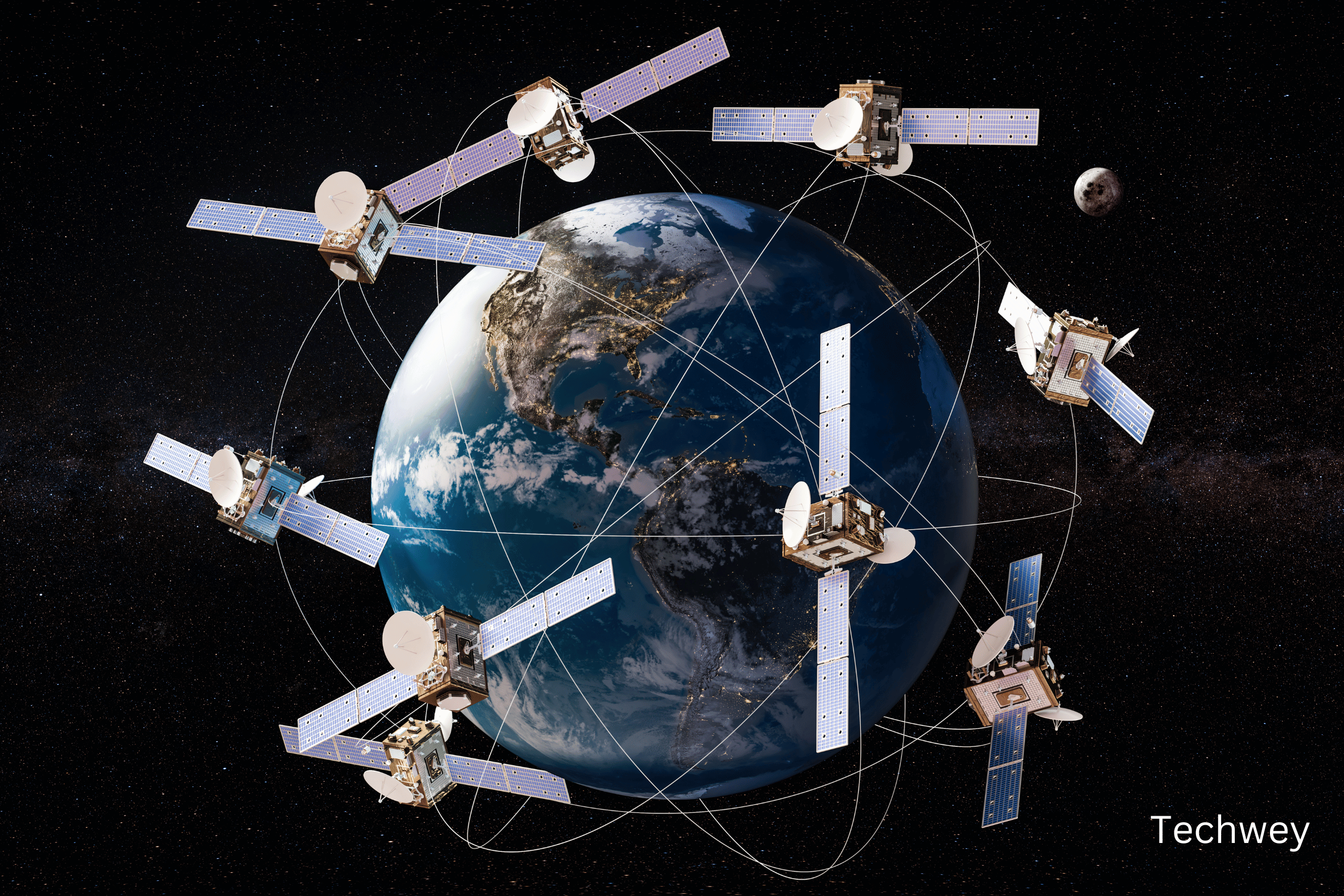
Starlink’s low-Earth orbit (LEO) technology is the key differentiator. Traditional geostationary satellites sit about 35,000 km above Earth, introducing latency that makes real-time applications — video calls, gaming, cloud software — frustrating. Starlink’s constellation orbits at around 550 km, cutting latency to 20–40ms, which is competitive with many terrestrial broadband connections.
But Starlink isn’t operating in a vacuum. Competitors are entering fast:
- Amazon’s Project Kuiper has launched satellites and begun phased rollouts, with Africa explicitly named as a priority market.
- OneWeb (now part of Eutelsat) already has commercial agreements with African ISPs and governments.
- Telesat Lightspeed is targeting enterprise and government contracts across the continent.
- African-backed ventures like Cassini are emerging, with ambitions to build satellite infrastructure owned and operated on the continent, not just sold into it.
The competition is healthy. It’s already driving pricing down and forcing faster rollouts.
What It’s Actually Unlocking on the Ground
Education in Remote Areas
Schools that previously had no internet — and teachers who relied entirely on printed materials — are now connecting classrooms to the global web. In parts of rural Kenya, Tanzania, and Ghana, satellite-connected schools are running digital curricula, participating in virtual exchange programs, and giving students access to online learning tools for the first time. UNICEF’s connectivity for education programs have begun integrating satellite as a core delivery mechanism in hard-to-reach zones.
Healthcare and Telemedicine
Rural clinics can now transmit patient records, conduct specialist consultations via video, and access medical databases that were previously unreachable. In emergency situations, reliable satellite connectivity has already saved lives in areas where the nearest hospital is hours away. Telemedicine pilots running on satellite infrastructure in Ethiopia and the DRC are showing outcomes that justify the investment.
Agriculture and Precision Farming
Smallholder farmers with satellite connectivity can access real-time weather data, soil analytics, market prices, and advisory services — tools that were previously available only to large-scale commercial operations. Startups like Apollo Agriculture are building precisely these data-driven advisory models for African farmers, and satellite internet extends their reach further into rural markets.
Small Business and Remote Work
The conversation about remote work in Africa often misses the obvious blocker: you can’t work remotely if you don’t have internet. Satellite connectivity is enabling a new class of African freelancers, remote employees, and rural entrepreneurs to participate in the digital economy without relocating to a city.
The Challenges Still Standing
Cost Remains a Barrier
Starlink’s hardware kit costs upwards of $300–$400 in many African markets — more than a month’s income for a significant portion of the population. Monthly subscriptions add another $30–$50+. This is dramatically cheaper than it was two years ago, but it remains out of reach for the most underserved communities without subsidy programs or shared-access models.
Several governments and NGOs are experimenting with community hub models — one satellite terminal serving an entire village through local Wi-Fi distribution — to close this gap.
Regulatory Friction
Not every African government has welcomed satellite operators with open arms. Some countries have delayed licensing, imposed spectrum fees, or restricted operations to protect incumbent telecoms. Regulatory unpredictability creates investment uncertainty and slows rollouts in markets that need connectivity most.
Dependence on Foreign Infrastructure
A real concern across the continent is that Africa’s connectivity backbone will remain controlled by non-African companies — subject to foreign pricing decisions, terms of service, and geopolitical pressures. This is why African-owned satellite ventures and regional regulatory frameworks like the African Union’s Digital Transformation Strategy matter so much.
What Comes Next
The trajectory is clear. Satellite coverage across Africa will be near-universal by 2027 or 2028. The differentiator will shift from availability to affordability, and from individual subscriptions to institutional and infrastructure integration — schools, clinics, government services, logistics networks.
The real opportunity for African tech entrepreneurs is not the satellite itself but everything built on top of it: the applications, platforms, and services that only become viable when you can assume connectivity almost anywhere. That market is enormous, and it’s only now starting to open.
Africa’s internet story is being rewritten from the sky down. And for the first time in a long time, the momentum feels genuinely unstoppable.
Read more tech related articles here: Techwey