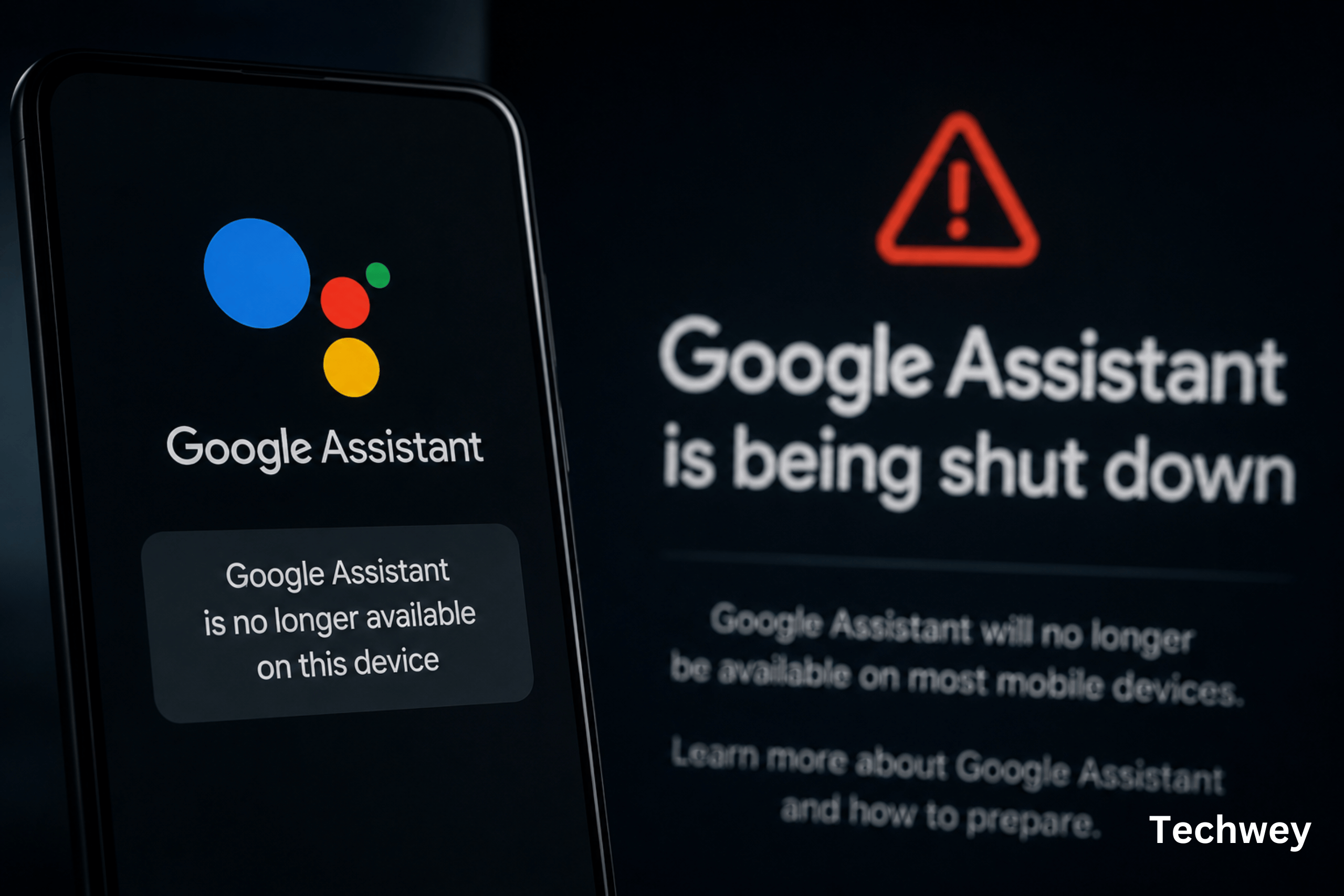
Google Assistant Is Being Shut Down on September 4.
ByMichael
Google Assistant launched in 2016. It became the default voice layer on hundreds of millions of Android phones, watches, headphones, and cars. It answered questions, set timers, controlled smart home devices, and became one of those features people use dozens of times a day without thinking about it.
It’s being removed in 25 days.
Google will begin removing Google Assistant from Android phones, tablets, Wear OS watches, headphones, and Android Auto on September 4, 2026, replacing it entirely with Gemini. The transition will roll out over several weeks. Once it hits your device, Assistant is gone for good.
Google sent emails to users this week notifying them of the change. The message is blunt: “As we transition our mobile experience to Gemini, Google Assistant will no longer be available on your mobile device. We will begin removing access to Google Assistant starting on September 4, and expect that this process may take a few weeks to reach everyone. Once availability is removed, you will no longer be able to use or switch back to Google Assistant on your phone, tablet or paired devices.”
No opt-out. No rollback. This is a one-way door.
What Gets Removed and What Stays
The removal covers Android phones and tablets, paired Wear OS watches, compatible headphones and earbuds, and cars using Android Auto projected from a user’s phone. But not everything switches at once. Cars with Google Built-in will continue to support Google Assistant. Google TV devices, Home speakers, and smart displays are not covered by the September 4 removal. Those will migrate on a separate timeline that Google hasn’t announced yet. There’s also a hardware floor. The standard Gemini mobile app requires Android 9 or newer and at least 2GB of RAM. Eligible Android Go phones use the separately distributed Gemini Go replacement. Older devices that fall below those requirements will retain Assistant for now — though Google hasn’t said for how long.Why the Delay — and What It Signals
Google originally planned to wrap up this migration by the end of 2025. That deadline quietly slipped to 2026, presumably to give the company more time to ensure Gemini could actually handle all the tasks Assistant users rely on daily. That delay is revealing. Even with Google’s resources, replacing a deeply embedded product across billions of devices is genuinely difficult. Gemini needed more time to reach feature parity with the Assistant functions that people actually use every day. Google has now set the date — but by its own admission, Gemini still isn’t a complete replacement.What Gemini Can’t Do Yet — And You Should Know About
This is the part of the story most coverage glosses over. Google is forcing remaining users onto Gemini even though its replacement still cannot perform every Assistant function. Here’s what Gemini currently lacks compared to Google Assistant:- Interpreter Mode. Assistant’s real-time translation feature — used by travellers, guides, and hospitality professionals — has no Gemini equivalent yet.
- Some podcast, news, and radio services. Gemini still lacks support for some podcast, news, radio and third-party music services.
- Certain routines. Automated chains of commands — “goodnight” triggering lights off, phone silenced, alarm set — may not fully carry over. Check your existing routines before September 4.
- Some media controls. Assistant’s deeper integration with third-party media apps worked in ways that Gemini doesn’t yet replicate fully.
What Gemini Does Better
To be fair, Gemini is genuinely more capable than Assistant in significant ways. The design philosophies are different. Where Assistant was optimised for single-command tasks, Gemini is built around longer conversations and synthesis. Ask Assistant to compare two products and it would typically redirect you to a search. Ask Gemini the same thing and it reasons through it. Google has been improving Gemini models like Gemini 2.6 Flash, Gemini 3.5 Flash Lite, and Gemini 3.5 Flash Cyber to deliver faster and more reliable performance using fewer tokens. Google has also introduced Gemini Spark, an AI agent model that can manage tasks more efficiently than Google Assistant. For most everyday users — setting timers, checking the weather, making calls, sending messages — Gemini does everything Assistant did and handles complex follow-up questions that Assistant couldn’t. The regression is real but narrow: it affects specific features rather than the core experience.What About Privacy?
This is a legitimate concern that deserves attention. Turning off Gemini’s Keep Activity setting prevents future chats from being used to train Google’s models unless feedback is submitted, but Google retains chats for 72 hours and disables integrations including Maps, Home, Workspace, and YouTube. In other words, you can opt out of training data use, but only at the cost of losing most of Gemini’s integrations. That’s a harder trade-off than Assistant presented. If privacy matters to you, go into your Google account settings and review what you’re comfortable with before the transition hits your device.How to Prepare Before September 4
You have 25 days. Here’s what to do with them.- Check your Assistant routines in the Google Home app and note which ones matter. You’ll need to recreate them in Gemini after the switch.
- Test Gemini now. It’s already available as an app. Spend a week using it as your primary assistant before you’re forced to — so you understand what works differently before it’s the only option.
- If you use Interpreter Mode professionally, start looking for alternatives. Google Translate’s conversation mode is a reasonable substitute for most use cases.
- Review your podcast and music app integrations. If you rely on voice commands to control a specific streaming service, check whether Gemini supports it.
- Check your car. If you use Android Auto via your phone rather than a built-in system, your in-car voice assistant is changing too.
The Bigger Picture
Google shutting down Assistant isn’t a minor product update. It’s the end of the pre-AI-era assistant and the beginning of something structurally different. When Google flips the switch, users don’t get a choice. Your Assistant data, routines, and integrations either migrate to Gemini’s framework or they disappear. There’s no opt-out, no portable format, no interoperability standard. That lack of user control is worth naming. Google made a platform-level decision to replace a product that billions of people had built habits around. Some of those habits won’t survive the transition. That’s the cost of moving an ecosystem forward — and it’s a cost users, not Google, will pay. The transition starts in 25 days. Use the time. For more on how Google’s Gemini is reshaping the Android ecosystem, see our coverage of how iOS 27 is opening up to Gemini and rival AI assistants — and what the AI assistant wars look like from both sides of the mobile market.Read more tech related articles here.