
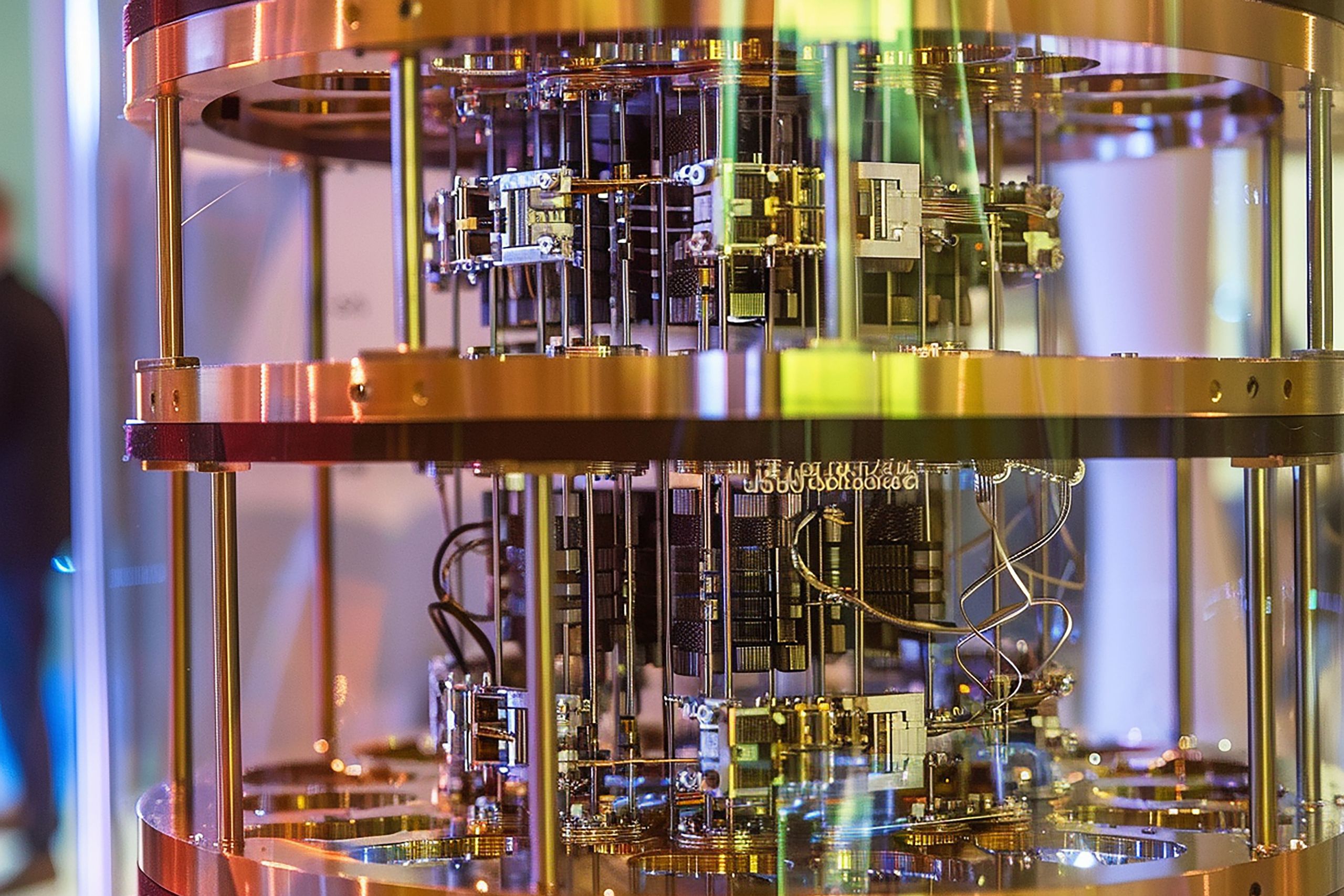
Imagine facing a problem so complex that it would take the world’s most powerful supercomputer longer than the age of the universe to solve it. Now, imagine solving it in just about five minutes. That’s exactly what Google has achieved with its groundbreaking Willow Quantum Chip — a marvel of modern science that’s redefining the boundaries of computation.
What Is the Willow Quantum Chip?
The Willow chip is part of Google Quantum AI’s ongoing mission to build scalable, error-corrected quantum computers. With remarkable precision and efficiency, this chip is able to perform calculations that would stump even the most powerful classical supercomputers — effectively leaping over technological barriers that have held back researchers for decades.
Speed That Defies Time Itself
In a recent demonstration, Willow completed a quantum computation in roughly five minutes. The same calculation would have taken a traditional computer an estimated 47 years multiplied by a trillion trillion (that’s 10-septillion) years. For perspective, the universe is only about 13.8 billion years old.
This seemingly improbable speed isn’t about working “faster” in the usual sense. Instead, quantum computers like Willow work fundamentally differently by harnessing the strange and fascinating world of quantum mechanics.
How Quantum Computers Break the Mold
Unlike classical bits that can be either 0 or 1, quantum bits—or qubits—can be in states of 0, 1, or both at the same time, thanks to a phenomenon known as superposition. This allows them to perform multiple calculations simultaneously. Combine that with entanglement, where qubits become instantly correlated no matter the distance, and you get an incredibly powerful platform for solving certain types of problems.
Key Innovations of the Willow Chip
- 54 qubits: The Willow chip was designed with enhanced stability and coherence time, meaning it can maintain quantum states longer and reduce computational errors.
- Improved gate fidelity: The operations between qubits saw unprecedented improvements in accuracy.
- Low error rates: Because quantum systems are notoriously prone to errors, Willow incorporates advanced error mitigation techniques to ensure reliable results.
Why This Matters
The implications of such breakthroughs extend far beyond flashy headlines. Quantum computing could revolutionize industries by providing solutions to incredibly complex problems, such as:
- Drug discovery: Simulating molecular interactions to find new medications in a fraction of the time.
- Climate modeling: Predicting weather patterns and climate shifts with greater accuracy.
- Optimization challenges: Revolutionizing logistics and supply chains for global businesses.
- Cryptography: Rethinking security as quantum computers challenge traditional encryption methods.
What Experts Are Saying
According to Dr. Hartmut Neven, Director of Google Quantum AI, “This experiment marks the crossing of an important milestone—achieving a computation that’s verifiably beyond the practical reach of classical supercomputers.”
Leading physicists and computer scientists alike agree: Quantum supremacy, once a theoretical concept, is now a demonstrated reality. But it’s just the beginning. As quantum hardware improves and error correction evolves, the true potential of quantum computing remains on the horizon.
Where Do We Go From Here?
While the Willow chip is a significant step forward, much work remains. Quantum computers are still in their early stages and aren’t ready to replace classical systems for everyday tasks. However, they’re ideal for solving certain niche problems with immense complexity.
- Scalability: Researchers are working on adding more qubits while maintaining stability.
- Error correction: Building reliable systems that can fix or tolerate errors is key to unlocking more applications.
- Programming models: Just like early programming for classical computers, we’re still learning how best to instruct these machines.
In Conclusion
Google’s Willow chip is more than just a technological leap — it’s a glimpse into a new era of computation. Solving a problem that would take a supercomputer eons in just minutes doesn’t just reflect speed; it symbolizes the massive shift quantum computing brings to the scientific landscape.
As this field evolves, it’s a thrilling time to stay curious, explore the quantum frontier, and see how this new wave of innovation could one day change everything — from how we research to how we live.
Read more tech related articles here.




Leave a Reply