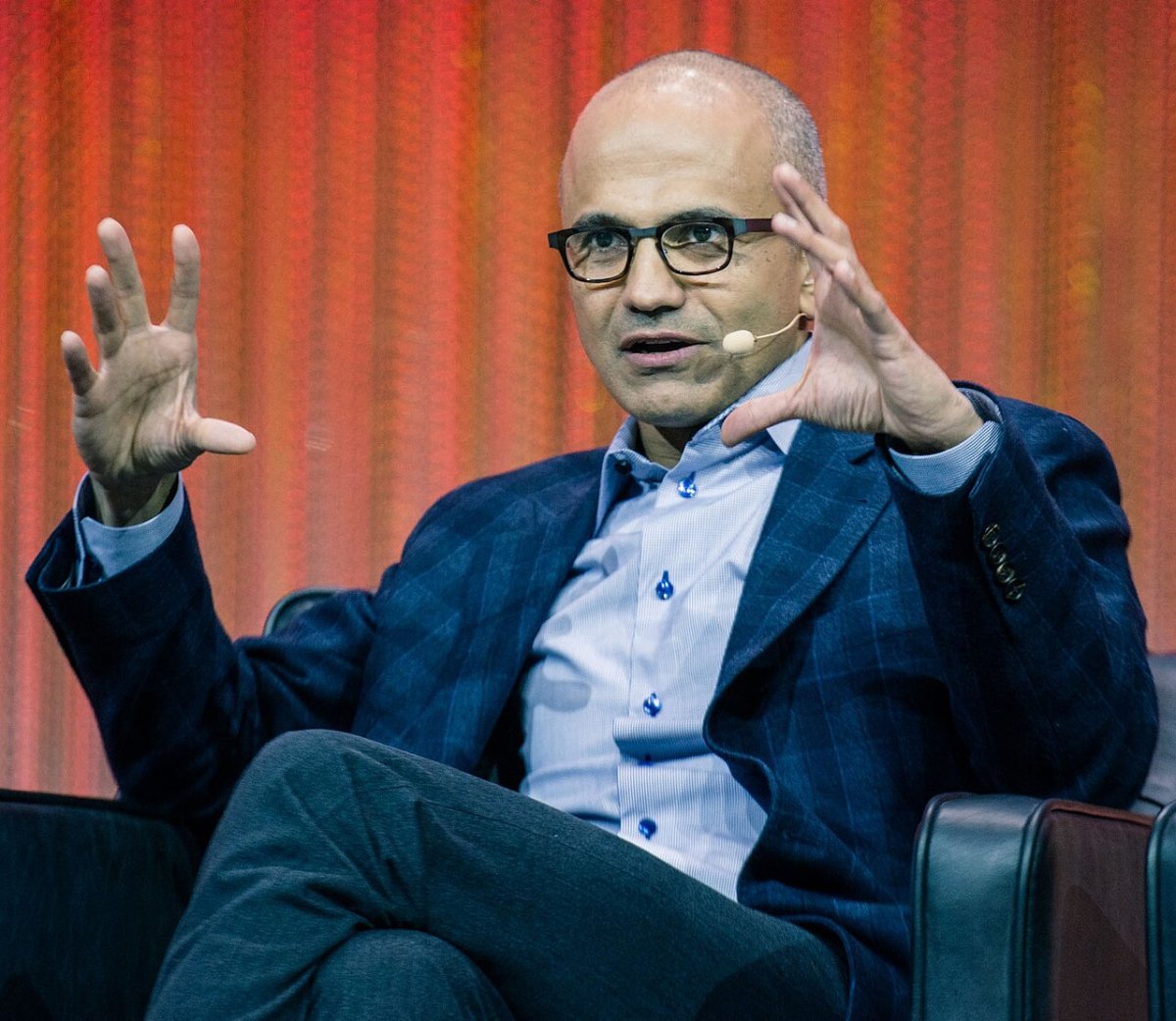
Satya Nadella Warns Companies: Using AI Means Paying Twice, Once With Money, Once With Your Data
Microsoft CEO Satya Nadella has published a striking blog post warning enterprise companies that every time they use a proprietary AI model, they are making two payments — one they can see, and one they cannot. The post, published on July 13, 2026, on his personal blog, has triggered widespread discussion in Silicon Valley because of who is saying it: the CEO of one of the largest investors in OpenAI and Anthropic.
The Satya Nadella AI warning centers on what he calls the “reverse information paradox.” His argument is simple but uncomfortable: AI labs sell intelligence, but to get useful results, you have to feed those models your most sensitive internal data. The smarter you want the model to perform for your business, the more you have to reveal — and that revelation is not free.
You Pay With Money. Then You Pay With Your Data.
“You essentially pay for intelligence twice, once with money, and again with something even more valuable: the proprietary knowledge you must reveal to make that intelligence useful,” Nadella writes. “The better you want the model to perform, the more of that knowledge you have to feed it!”
Most enterprises understand that they pay per token — the unit that measures how much text an AI model processes. What they may not fully appreciate, Nadella argues, is that they are simultaneously handing over something far harder to price: the institutional knowledge embedded in how their employees write prompts, fix mistakes, and direct AI agents.
Models, he explains, learn from what he calls “exhaust” — the trail of data left behind by everyday AI use. “The prompts people write, the tools agents use, and especially the corrections people make when the model is wrong,” all become training signals. “Every correction is distilled into institutional know-how,” Nadella writes — calling this “the kind of knowledge a competitor could never buy.”
And yet, under the current arrangements many enterprises have signed, the AI labs may be free to learn from exactly that data.
The Trojan Horse Fear
Nadella is not the first to raise this concern. The worry has been circulating among investors and operators for some time: that the giant AI labs — OpenAI, Anthropic, Google DeepMind — are not merely tools for their enterprise customers, but potential future competitors who are learning everything about those customers’ businesses in real time.
Prominent venture capitalist Jason Calacanis has flagged this publicly, as has Palantir CEO Alex Karp. But Nadella’s entry into this conversation carries a different weight: he runs a company that has invested billions in OpenAI, distributes its models through Microsoft Copilot, and sells the cloud infrastructure that many of these same enterprises run their AI workloads on. His willingness to issue this warning publicly is itself a signal.
The Distillation Double Standard
Nadella’s critique goes beyond data privacy — he also takes aim at what he sees as a hypocrisy in how AI labs treat knowledge transfer.
“Distillation” is the practice of using a model’s own outputs to study how it works and train a cheaper, often smaller model from those insights. In February 2026, Anthropic accused Chinese open source AI labs of sending millions of prompts to Claude as a method for improving their own models — a practice Anthropic called misuse and urged the U.S. government to restrict.
Nadella’s point is that model makers cannot have it both ways. “While the great innovation that comes from model providers having fair use rights to train models on public data is needed, I find it ironic that the status quo is to then turn around and impose restrictive terms on distillation,” he writes.
Put simply: the labs trained their models on the world’s data without asking permission. But they are now drawing sharp legal lines around who can study their models in return. Nadella calls that a double standard.
What Nadella Thinks Companies Should Do
Nadella’s prescription is the kind of thing you might expect from the CEO of a cloud platform, but it is also practically sound. He urges companies to retain ownership of their data — including every prompt, piece of feedback, and agent interaction — and to build what he calls “proprietary learning environments” where that data stays under their control.
He also advocates for “orchestration layers” — technology that lets companies easily switch between AI models from different providers, rather than becoming locked into one lab’s ecosystem. Tools that do exactly this, commonly called AI gateways, have been growing in popularity. Vercel (best known for web hosting) and OpenRouter both offer model-switching infrastructure and have reported surging traffic as enterprises experiment with routing requests across multiple providers.
The Open Source Shift Is Already Happening
While Nadella stops short of explicitly advocating for open source AI, it is the obvious subtext of his argument — and several industry leaders say the shift is already underway on the ground.
Idit Levine, founder and CEO of Solo.io — a networking and security company that helps enterprises manage AI systems and whose technology powers the Linux Foundation’s Agentgateway project — says she is already seeing this play out among her own enterprise clients.
“Can I take an open source model and run it on-prem? It will do almost 90% of what the big one’s doing. It will cost way less,” she told TechCrunch, paraphrasing the thinking of enterprises like T-Mobile, ADP, and SAP — all customers of Solo.io. “They understand that, and they can control it.”
The numbers back this up. Open source models accounted for 29% of all AI traffic routed through Vercel’s gateway last month — a figure that reflects real enterprise decision-making, not just experimental curiosity.
Why This Warning Matters
The fact that Satya Nadella — whose company is deeply entangled with the very AI labs he is warning against — is now publicly urging enterprises to protect their data and avoid lock-in sends a clear message. The AI market is maturing, and the terms of engagement are coming under real scrutiny.
For companies currently building AI workflows on top of proprietary models from OpenAI or Anthropic, Nadella’s warning is worth taking seriously. The question is not just what the AI can do for you today — it is what you are teaching it about your business in the process, and who gets to keep that knowledge tomorrow.
“In consuming intelligence, you are creating intelligence,” Nadella writes. “And what you create should belong to you.”
Read more tech related articles here.